- Thinking About It by Zee Feed
- Posts
- Don't get sucked into the binaries
Don't get sucked into the binaries
On the US-Iran war

Roumina Parsa
March 15, 2026
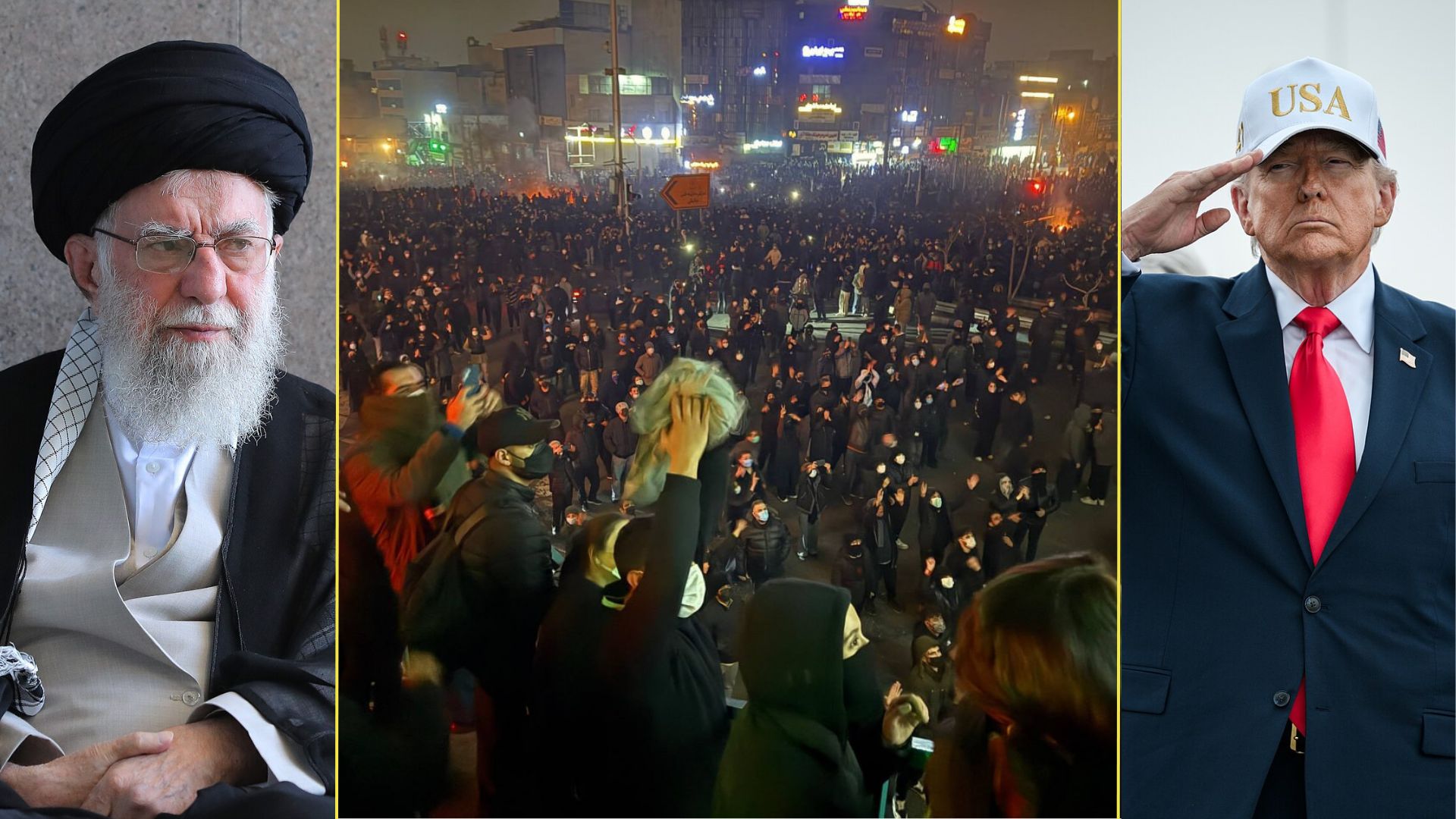
The US-Israel strikes on Iran in late February have now developed into war – a war that the Australian government fully supports and is now militarily involved in. It goes without saying at this point: the extent to which the US has shredded any semblance of international rules is outrageous. But I’ve also been very troubled by how quickly the the news focus of the war switched away from the Iranian people and those in other countries being attacked. Now the headlines are dominated by strategy talk and oil.
The state of online discussion about the war has also been alarming, especially in progressive spaces. Today for Zee Feed, Iranian Australian writer Roumina Parsa explains why we need to resist the good vs evil binary, especially in progressive spaces where eagerness to stand against the US can ends up sounding a lot like support of Iran’s theocratic regime.
It’s a read that may challenge what some of what you’ve heard and read, but is worth taking in.
Don’t get sucked into a binary view of the US-Iran war by Roumina Parsa
The “Middle East” as a volatile location of interest has in recent years experienced a resurgence in the West’s consciousness. Bearing witness to the Palestinian genocide through social media was a major catalyst for many to pursue a greater understanding of imperialism, colonisation and occupation, and reverse the sentiments triggered by 9/11. But as political consciousness has increased, it has also narrowed. Disillusionment with one simplistic explanation of the Middle East has materialised another. And somewhere in the midst of pursuing just causes, moral consistency has been sacrificed for an allegiance to polarising ideologies.
Now, responding to the war in Iran, many Western leftists have applied the same anti-imperialistic perspective to highlight the violence of the U.S and Israel . Yes, these colonising forces have once again actioned their powers through violence. But this does not come with equal condemnation of the Islamic Regime – demonstrating not only a limited view of Middle Eastern politics, but ignoring and sidelining the very people the ‘discourse’ intends to aid.
Faced with imperialism and fascism, some progressives have struggled to reject both. Instead, they’ve ironically returned to putting the US at the centre. It’s “the devil you know” manifesting as a warped new form of colonialist thinking, contextualising the racial other only in relation to the West to combine oppressor and oppressed under the shared umbrella of “victim” – all the while dubbing it allyship.
Naturally, a singular narrative is the easiest one to engage with. Good vs Evil is the oldest tale. Acknowledging the real similarities between the US, Israel and the Islamic Regime is a much more difficult conversation. It demands a willingness to learn truths that contradict our learned biases and, more importantly, to return to a grounding of empathy and shared humanness. That is what makes it all the more necessary. As the burden has fallen on Iranians to perform this work and prove the validity of our fight, let me be yet another Iranian to do it.
When protests recommenced in Iran in December of last year, the government response was swift, brutal and familiar. Shoot to kill orders from the now-dead Ayatollah Khamenei initiated a systemic massacre of Iranians nationwide. Videos showed the IRGC employing battlefield weapons against unarmed civilians, actively protesting or otherwise. Military vehicles were used to mow citizens down. Those that took shelter in nearby houses or sought treatment in hospitals were followed and shot at close range. Bodies of the dead as well as the wounded were abducted, held as ransom by the government for payment or false confessions from family members, if ever returned. Detained protesters have reported being tortured and abused, including accounts of sexual abuse.
Thousands of people have been massacred – the death toll varies from 7000 to potentially as high as 40,000 – but due to mass public suppression and a lack of transparency from the Regime, exact numbers are unable to be known. The dehumanising experience of watching this number be debated is not something I intend to resume here. Whether it is one or 100,000, the fact remains: the Islamic Regime brutally and intentionally terrorises, maims, and kills civilians, and continues to do so, even in the midst of war. This violent subjugation is not an anomaly to be attributed to extraordinary periods of high tension. It is the very foundation upon which the Regime was built 47 years ago – the same fascist ideology the Western left claims to oppose, actioned to its most extreme.
And yet, as the death of Khamenei was announced, leftist “allies” oscillated between condemning Trump and Netanyahu for foreign interference and tone-policing Iranians who reacted in celebration. A commenter called “Matt” said it eloquently on one of my recent TikTok posts: “Don’t you know people are being bombed?” Yes, I do. Assuming ignorance by Iranians – of war, of foreign intervention, of imperialism – has galvanised those with the least at stake to be the loudest voice.
These voices insist the Islamic Regime’s supposed fidelity to Palestine is evidence of their commitment against “the Empire”. They lecture us to distrust leadership associated with Jeffrey Epstein, but to back the regime that legislates paedophilia through marriage and hangs teen rape victims. We are demanded to mourn for the 165 girls lost in the bombing of the Minab school, but denied grief for the 1200+ girls poisoned in schools in 2023, the 17% of women forced into marriage as children, the 200+ children killed in state violence this year alone.
To add to the irony, much of this discourse takes place on the very social media Iranians are unable to access as they are yet again plunged into an internet blackout, leaving them voiceless in the discourse on their own lives. The complexity of their experiences is flattened and decontextualised from historical and cultural nuances. Agency is lost, as is their dimensionality as humans. Every incorrect contrast drawn projects a level of naivety onto Iranians so they can be used as fodder for anti-imperialist, anti-US talking points. Die if you must, the “Matts” of the world seems to say, so long as it is against the correct enemy.
We need to change the way we talk about Iran. Conversation must start from Iranians, moving outwards with care, patience, and an understanding that for us, this is not a neutral, theoretical subject. Condemnation of war must be accompanied by condemnation of the regime. The theocratic regime is not made any more ethical for being precise in its movements, especially because this precision is also targeted towards its own citizens.
If the plan is to find justice for one group specifically through the subjugation of another, be assured, it will not work. Because liberation through subjugation of another is never true liberation. You do not actually grow taller by standing on someone else’s head. It simply transmutes the suffering, and continues the same flat narrative by a different name.