- Thinking About It by Zee Feed
- Posts
- What is the point of a prison?
What is the point of a prison?
Plus, Meta is targeting meme accounts.

Crystal Andrews
November 16, 2025
What is the point of a prison?
I’m asking both rhetorically and seriously. What purpose does A Prison serve in the justice system, and more broadly in Australian society? Two stories from Victoria this week paint a really confusing picture about what role prisons should play in a healthy and safe society.
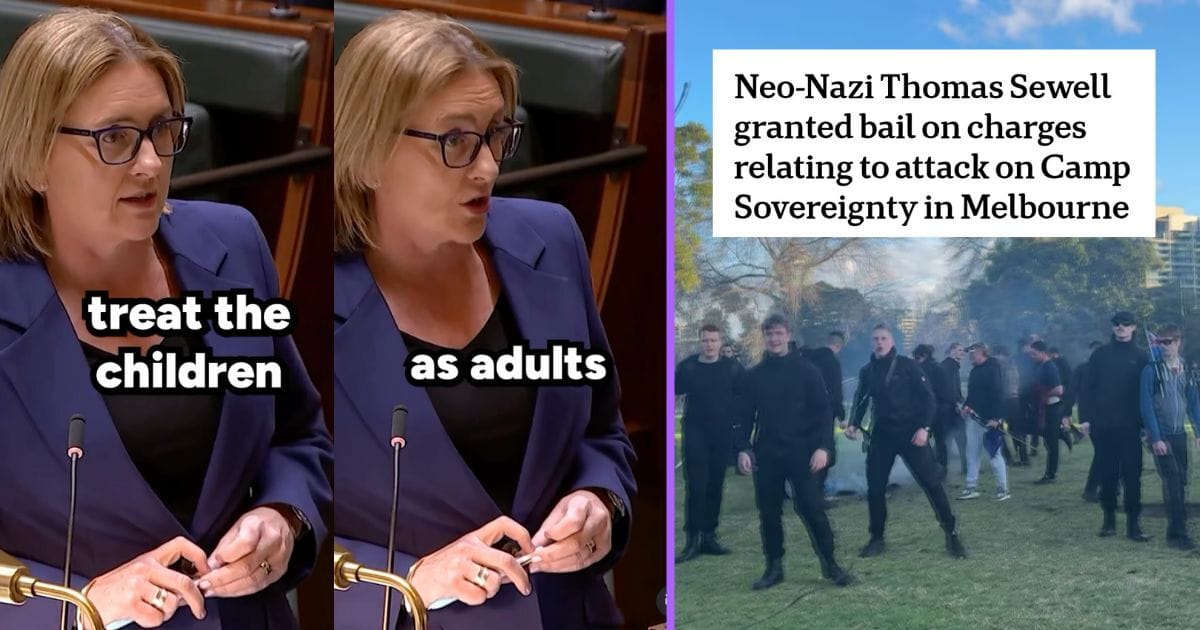
The Victorian Labor government, under Premier Jacinta Allan, introduced the ‘Adult Time for Violent Crime’ reforms. You can read the statement here, but in a nutshell for a 14-year-old kids convicted of any of the specified crimes the government wants to:
Make it easier for judges to send the child to jail, and;
Increase the length of jail time, including allowing a child to be sentenced to life in prison.
Victorian Labor thinks these are good things that will improve community safety. They think that a child who is convicted of committing these (very serious and dangerous) crimes should be treated like an adult, despite the fact that children are not at all like adults.
There’s heaps to unpack in this story: the fact that these laws are the result of conservative media campaigning from radio hosts and newspaper columnists; the fact that Victoria’s ‘crime crisis’ is being driven by huge increase in theft and burglary rather than assault; or the fact that even though youth crime has increased (by 17%), only 13% of criminal offenders in Victoria are children, and they are mostly committing robberies, aggravated burglaries and car theft.
But it’s the supposed role of incarceration that I find the most confusing.
Earlier this year, the same Victorian government significantly cut funding for youth crime prevention programs. Which is weird because, until 2025 the number of unique offenders was steadily decreasing (except for one spike during the COVID-19 lockdowns). Some of those programs must have been working.
But based on the decisions the Victorian government made, we have to assume it didn’t think the programs were working, and that it believes tougher prison sentences will be more effective at reducing crime.
Which would also be weird, because the state government’s own research shows that almost 40% of people released from prison in the 2021/22 financial year were back in prison just two years later (for reference, that national two-year recidivism rate is 43%). Sure, the clear majority do not return to prison – that’s good! – but a 40% return rate seems high to me.
By definition a prison sentence cannot stop crime from happening — it’s only an option once a crime has already been committed. The decision to cut prevention programs while increasing prison sentences for kids doesn’t seem like it would actually make a community safer.
Is the purpose of a prison to ‘rehabilitate’ the child, so they don’t commit additional crimes? Or to isolate a child that is simply too dangerous to be part of society? Is it to help the offender, or to help the community at large?
This week, also in Victoria, Nazi leader Thomas Sewell was granted bail — that means he is free to be part of the community at large (with curfews and travel restrictions) while he waits for his trial. A few important details:
Sewell is an adult, not a child;
He is charged with 25 offences, including assault, for allegedly leading a violent attack on an Indigenous encampment;
He is the leader of a hate group (that some argue should be designated as a terrorist organisation);
He has previously been convicted of assaulting a Black security guard, for which he served community service hours, not jail time.
Is this adult dangerous to the community? According to the courts this week, Sewell does not pose a threat to anyone right now.
This decision really challenges the Victorian government’s idea of what a prison is supposed to do. Sewell clearly needs rehabilitation, but he’s never been to jail; does that mean jail time cannot really rehabilitate an offender? Sewell is also a clear danger to others, especially Indigenous, Black, Asian and Jewish people. But again, he’s never been to prison; does that mean prisons are not useful for isolating those who are a danger to the rest?
Australia was a penal colony. This country had prisons from Day 1 of colonisation, yet we’ve had people committing anti-social and violent behaviours the entire time. If prisons were the solution for a healthy, crime-free society, we’d already have it!
That said, I don’t want to minimise any of this. We should not be sentencing children to life in prison, but I’m not exactly sure what role I think incarceration should or could play in achieving justice for the victims of violence and holding perpetrators accountable. I also have complicated feelings about how some feminist voices advocate for carceral solutions to gendered and family violence, worthy of discussion on its own.
For now, it all comes back to that first question: what is the point of a prison? The inconsistency in how Victoria wants to treat kids vs how it treats violent adult Nazis makes it clear that they don’t know the answer either. Children shouldn’t be the experiment used to figure it out.
Smart stuff on the Internet 💭
All the stuff I found on the web that made me think, smile, or have an ‘aha!’ moment. Spend your Sunday reading them – you'll be better off for it:
Instagram is Killing Off Meme Accounts on Reality Studies
“Certainly there are right-wing memers who will suffer under this policy shift, but I believe the impacts will be felt much more acutely among progressive accounts. In the contemporary Western media ecosystem, the spectrum of what we consider mainstream has vanishingly little representation of leftist perspectives … Right-leaning views (and recently, even right-wing extremism) are increasingly platformed both in “mainstream media” and a bevy of more fringe outlets. So even if there are an equivalent number of meme accounts across the political spectrum who will be hit by this change equally, the role that left-leaning accounts play in the news ecosystem is proportionally greater for their respective communities.”
It soothes my bitter heart to know that no matter how much money Elon Musk has, he will never, ever be funny on Guardian Australia
Rebecca Shaw is hilarious, I loved this and the video of Musk in it is so cringe it’s painful. “It’s that I know for a fact that Musk will never feel truly satisfied. Because no matter how much money he has, how many people he buys to do what he wants, how many bootlickers he keeps around – he will never, ever be funny. What Musk really wants his billions can’t buy: being able to get a true laugh.”
Netflix's 'Selling' Franchise Has a MAGA Problem on Marie Claire UK
“Selling the O.C. and Selling Sunset’s twin political controversies have capped off a year in reality fandom where unscripted television is no longer a politics-free zone. Docu-soaps are often supposed to sustain a capitalist fairytale, where any viewer can find someone to relate to and cheer for among the cliques. But as politics becomes more stratified and everyday people find their rights threatened, even the casts of these series haven’t been able to escape from the changing world.”
Mecca defends signing up kids without parents’ permission on Sydney Morning Herald
I do not like this... “Multiple ex-Mecca staff who spoke to this masthead on the condition of anonymity expressed concerns that their colleagues would routinely accept school student email addresses with @edu domains to sign up customers as Beauty Loop members without parental permission. While Mecca’s own rules mandate parental consent for any members under 18, it does not require any proof. As a result, child members could be receiving randomised free product gifts unsuitable for their skin, Mecca has conceded.”